

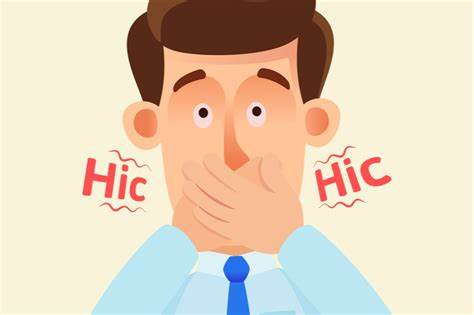
Everyone has a favourite hiccup cure: drink water, hold your breath, swallow a spoonful of sugar, get someone to scare you. So how do you actually get rid of hiccups? The honest answer is a little less exciting. Most hiccups disappear on their own within a few minutes, and there is surprisingly little good evidence that any home remedy reliably stops them. Some simple tricks are reasonable to try, but they may get the credit simply because the hiccups were about to stop anyway. So what causes that strange little “hic” in the first place?
What hiccups are
A hiccup begins with an involuntary contraction of your diaphragm, the large sheet of muscle beneath your lungs that does most of the work of breathing. The sudden contraction pulls air in, and almost immediately your vocal cords snap shut, cutting off the rush of air and making the familiar sound. The medical name is singultus. It is a brief reflex involving the diaphragm, the breathing muscles, the nerves that control them and parts of the brain that manage breathing. It is normally harmless, but once it starts firing repeatedly, there is not much you can consciously do to tell it to stop, and nobody is entirely sure why the reflex exists at all.
So, how do you get rid of hiccups?
For an ordinary bout, there is no guaranteed cure, and most episodes stop by themselves within a few minutes. If you want to try something, simple, harmless options include taking small, slow sips of cold water, holding your breath briefly before breathing normally again, pulling your knees up towards your chest and leaning forward for a short time, or swallowing a little sugar. The explanations for why these might help vary; some may briefly change your breathing, and others may stimulate nerves involved in the hiccup reflex.
The important thing is not to mistake a plausible explanation for proof. As ScienceAlert notes, most cases resolve with nothing more than patience, and the only remedy it describes as having shown real promise is a special straw called HiccAway, designed by a neurologist. Terence Anthoney, the doctor who treated the man with the world’s longest case of hiccups, put it neatly: most cures work because the person’s hiccup clock has simply run out, as West Side Spirit reports. If your hiccups stop 30 seconds after a glass of water, it is very tempting to credit the water. It might have helped, or they might simply have run their course.
There are plenty of stranger cures, from drinking upside down to pulling your tongue, and none has emerged as a reliable fix. Some internet remedies are best left alone altogether, particularly anything involving choking, extreme breath-holding, awkward positions or deliberately restricting your oxygen. There is no need to turn hiccups into a trip to the emergency department.
Why do we get hiccups?
This is where it gets interesting, because scientists still do not have a definitive answer. One idea is that hiccups are an ancient reflex left over from an earlier stage of our evolution. Another is that they have a role in early development. Babies hiccup a lot, and even hiccup in the womb. In a 2019 study at University College London, researchers led by Kimberley Whitehead recorded the brain activity of 13 newborn babies while they hiccupped, and found that each hiccup set off a distinct burst of activity in the brain. They suggested this could help a developing brain learn to recognise and control the muscles used for breathing, according to a summary of the research. That is still a hypothesis rather than a proven explanation for why adults hiccup, but it suggests hiccups may not be a useless glitch after all.
What triggers hiccups in adults
Most short bouts have no serious cause. Common triggers include eating too much or too quickly, fizzy drinks, alcohol, very hot or cold drinks, swallowing air, sudden changes in temperature, and excitement, stress or laughter, as Australian health insurer Medibank describes. A full, stretched stomach can irritate the nerves involved in the hiccup reflex, which helps explain why a big meal can set them off, though usually the trigger is impossible to pin down. Persistent hiccups are different. Medibank notes that some lung and brain disorders, and certain medications, can affect the diaphragm and make hiccups more likely, which is why a long-running bout should not be dismissed as just a stubborn case.
When to see a doctor
If your hiccups last more than 48 hours, see a doctor. Hiccups lasting more than two days are called persistent, and those lasting more than a month are called intractable. Long bouts can interfere with eating, drinking and sleeping, and can cause exhaustion and weight loss, as ScienceAlert explains, and they can sometimes be a symptom of another medical problem that needs investigating. See a doctor sooner if hiccups come with other symptoms that worry you, such as difficulty breathing or significant pain. For non-urgent advice, call Healthdirect on 1800 022 222, and in an emergency, call 000.
The man who hiccupped for 68 years
Most of us are fed up after five minutes. Charles Osborne had hiccups for about 68 years. A farmer from Iowa, he started hiccupping in 1922 while trying to weigh a hog before slaughtering it, and they continued until 1990, according to Guinness World Records. He hiccupped between 20 and 40 times a minute, an estimated 430 million times in all. Osborne himself believed he had burst a tiny blood vessel in his brain while lifting the hog, though the cause was never confirmed, and doctors tried all sorts of treatments without success. Then, after nearly seven decades, the hiccups simply stopped. Remarkably, he still married twice and had eight children, and he remains the Guinness World Record holder for the longest attack of hiccups, as Smithsonian Magazine also recounts. So the next time a bout of hiccups has been bothering you for ten minutes, spare a thought for Charles Osborne.
Hiccups are a good example of the body running an automatic process without asking permission. Your body is constantly adjusting things such as breathing, temperature and blood chemistry to keep them in range, which I explore in what is homeostasis?, and if you are curious about another involuntary reflex with a surprising backstory, see what are goosebumps?
This article is general information only and is not medical advice. Most short bouts of hiccups are harmless, but hiccups lasting more than 48 hours should be checked by a doctor. For health advice in Australia, call Healthdirect on 1800 022 222. In an emergency, call 000.
Sources
- Guinness World Records: The extreme measures a man with a 68-year attack of hiccups took to try and stop them
- Smithsonian Magazine: The curious case of Charles Osborne, who hiccuped for 68 years straight
- ScienceAlert: The incredible true story of the man who had hiccups for 68 years
- West Side Spirit: One man hiccuped for 68 years
- Medibank: What causes hiccups?
- I/O Plus: Hiccups are key to a baby’s development, on the UCL study